
How Lasers and IPL Devices Target Different Structures in Skin
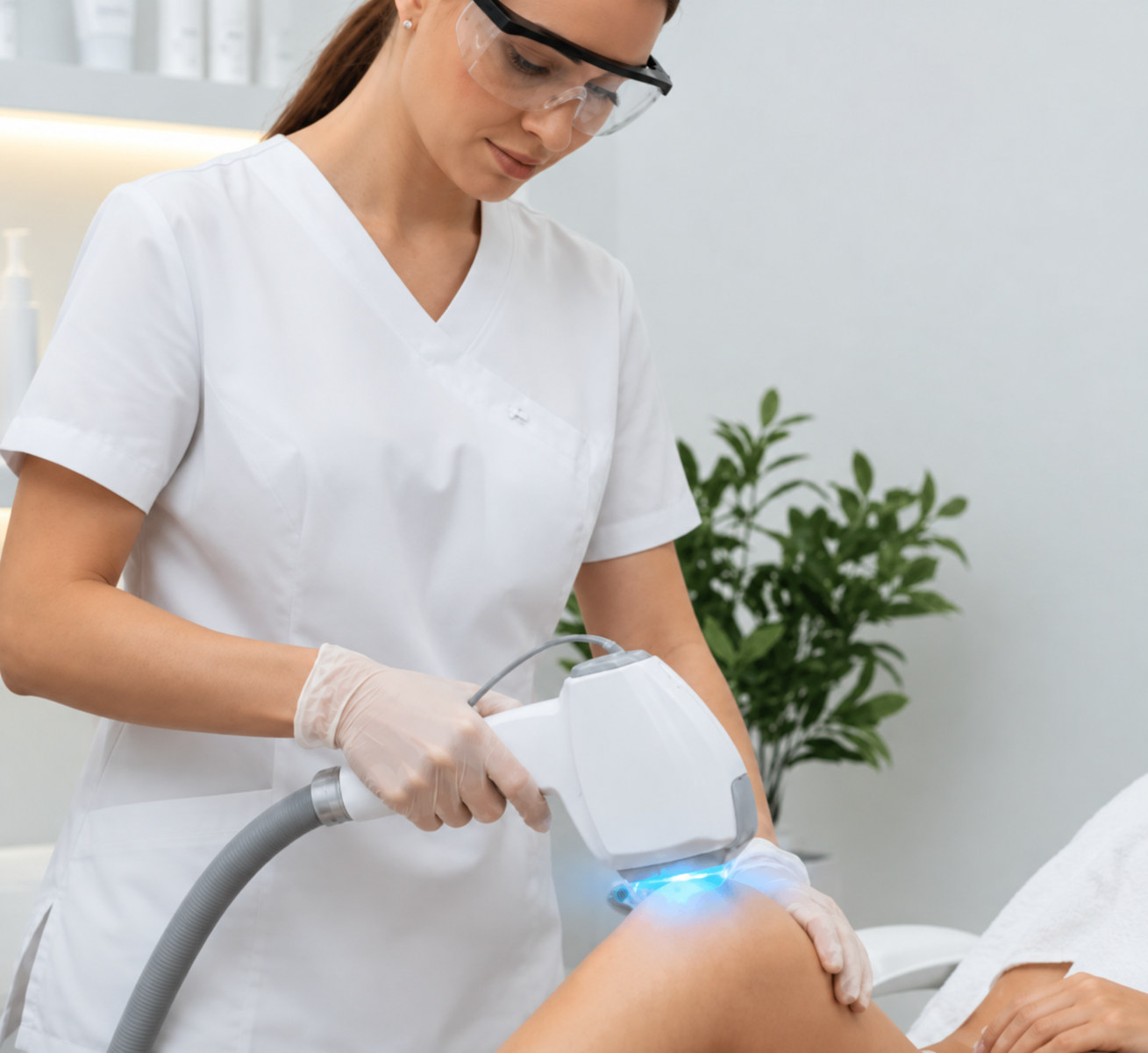
A med spa treatment room can hold four devices that all deliver light and all produce completely different clinical outcomes. Staff who understand why a 1064 nanometer beam reaches a leg vein while a 532 nanometer beam stops at a superficial capillary can prepare the right room, anticipate the right endpoint, and recognize when something is going wrong. Staff who only know the device by its trade name cannot.
The physics involved is not complicated and it is worth learning properly, because every safety rule in a laser room follows from it.
Selective photothermolysis
The principle behind every aesthetic laser was described by Anderson and Parrish in 1983. Light of a given wavelength is preferentially absorbed by a specific target molecule in tissue, called a chromophore. If the energy is delivered in a pulse shorter than the time that target needs to cool, heat builds inside the target and destroys it while the surrounding tissue stays intact. Choose the wrong wavelength and the energy is absorbed by the wrong structure. Choose the wrong pulse duration and heat spreads outward into tissue you intended to protect.
Skin offers three chromophores that matter in aesthetics. Melanin absorbs strongly across the visible and near infrared range, which makes it the target for hair removal and pigment work and simultaneously the reason darker skin carries higher risk on almost every device. Hemoglobin absorbs in defined peaks that make vascular lesions treatable. Water absorbs in the mid and far infrared, which is what allows resurfacing devices to vaporize tissue in a controlled layer.
Wavelength determines depth
Shorter wavelengths are absorbed and scattered near the surface. Longer wavelengths penetrate deeper before their energy is exhausted, up to a point in the infrared where water absorption becomes so strong that penetration collapses again. This is why a 532 nanometer beam works on a superficial telangiectasia on the cheek and a 1064 nanometer beam reaches a reticular vein on the leg, and why a 10600 nanometer carbon dioxide laser removes tissue at the surface rather than heating anything deep.

The practical consequence for a treatment plan is that depth of the problem, not severity of the problem, drives device selection. A deep dermal pigment process will not clear with a device that deposits its energy in the epidermis no matter how many sessions are added, and repeated attempts risk driving inflammation and post inflammatory hyperpigmentation instead.
IPL is not a laser
Intense pulsed light is broadband, non coherent light produced by a flashlamp across a wide range of wavelengths, commonly from around 500 to 1200 nanometers. Cut off filters block the shorter portion of the spectrum so the delivered band suits the intended target, which is why the handpiece filter selection is a clinical decision and not an accessory choice.
Because IPL delivers a spread of wavelengths simultaneously, it treats mixed superficial pigment and vascular change efficiently across a large area, which is the reason it remains the workhorse of photorejuvenation. The same breadth makes it less precise than a laser and less forgiving in higher Fitzpatrick phototypes, since a portion of the emitted spectrum will always be absorbed by epidermal melanin.
Ablative, non ablative and fractional
An ablative device vaporizes the epidermis and a controlled depth of dermis using water as the chromophore. Carbon dioxide at 10600 nanometers and erbium YAG at 2940 nanometers are the two mainstays. The remodeling response is powerful and so is the downtime, measured in one to two weeks of open healing followed by weeks of erythema.
A non ablative device heats the dermis while leaving the epidermis intact, producing a milder collagen response with far less recovery. Fractional delivery, available in both categories, treats a percentage of the surface in a grid of microscopic columns and leaves untreated tissue between them to drive faster healing. Fractional ablative resurfacing at a low density gives a practice a middle option between an aggressive full field treatment and a series of non ablative sessions.
Patients rarely understand that these are different categories of treatment rather than different intensities of the same one. A patient who consented to a non ablative session and expected an ablative result is a consultation failure, not a device failure.
Phototype and risk
Every device that uses melanin as a target or crosses melanin on its way to a deeper target carries elevated risk in phototypes IV through VI. The relevant risks are epidermal injury, post inflammatory hyperpigmentation and, less commonly, hypopigmentation that may be prolonged. Longer wavelengths such as 1064 nanometer Nd YAG bypass more of the epidermal melanin and are generally the safer choice for hair removal and vascular work in richly pigmented skin, paired with aggressive cooling and conservative fluence.
A documented test spot in an inconspicuous area, assessed at an interval appropriate to the device, is the standard of care in higher phototypes and in any patient with a history of pigmentary reaction. Test spots that are performed and not documented protect no one.
What the clinical support role covers
The Aesthetic Medical Assistant is rarely the operator, since laser operation is regulated at state level and in many states restricted to specific licensees under defined supervision. The assistant is almost always the person who makes the treatment safe and repeatable around the operator.
That means confirming that the door is closed and the warning signage is posted, that windows are covered, that every person in the room including the patient is wearing eye protection rated for the specific wavelength in use, and that no alcohol based prep or flammable material is present near an ablative device. It means confirming photoprotection history, recent sun exposure, isotretinoin use, active herpes simplex and antiviral prophylaxis where the protocol requires it, and any recent chemical treatment on the same area.
It also means the device log. Date, patient, device, handpiece, filter, fluence, pulse duration, spot size, number of passes, cooling settings, observed endpoint and any immediate reaction. Practices that treat this log as paperwork discover its value only when an outcome is questioned and there is nothing to reconstruct.
Endpoints and escalation
Expected endpoints depend entirely on the device and the target. Perifollicular erythema and edema in hair removal, transient darkening of pigmented lesions, immediate whitening on a vessel, controlled pinpoint bleeding in fully ablative work. What does not belong on that list is immediate gray white epidermal frosting outside the intended pattern, blistering during the session, or pain that escalates rather than settles between pulses. Any of those means the pass stops and the operator reassesses before continuing.
In the days after treatment, the findings that require the supervising clinician rather than reassurance are blistering, spreading erythema with warmth or discharge, and a pigmentary change that is worsening rather than fading. Route these the same day and photograph them.
Energy based devices generate the highest revenue per treatment room in most med spas and they also generate the highest severity complaints. The gap between those two outcomes is almost always protocol discipline rather than equipment quality.
If there are topics you would like to see covered next, write to us at editorial@upsthetics.com.
This article is educational and does not constitute medical advice, treatment guidance or device operating instruction. Always follow the manufacturer’s instructions for use, your practice protocols and the direction of your supervising physician. Device operation requirements and supervision rules vary by state and change over time.
FAQS
What is the difference between IPL and laser?
A laser emits a single coherent wavelength. IPL emits a broad band of wavelengths from a flashlamp, shaped by cut off filters. IPL covers mixed targets over large areas, a laser treats one target with more precision.
Why do longer wavelengths go deeper?
Shorter wavelengths are absorbed and scattered close to the surface. Longer wavelengths travel further before their energy is absorbed, until water absorption in the far infrared limits penetration again.
Is laser treatment safe in darker skin?
It can be, with the right device and settings. Longer wavelengths, conservative fluence, effective cooling and a documented test spot reduce the risk of burns and post inflammatory pigment change, which is higher in phototypes IV through VI.
Can a medical assistant operate a laser?
This is decided at state level. Some states permit trained unlicensed personnel to operate certain devices under defined supervision, others restrict operation to specific licensees. Confirm with the state medical board before assuming.
What is fractional treatment?
The device treats a fraction of the skin surface in a grid of microscopic columns and leaves untreated tissue between them. Healing is faster than full field treatment at the same depth. One more thing
Stay Updated
Related posts
Pressotherapy for lymphatic drainage: benefits, safety considerations, and professional use
How Platelet Rich Plasma and PRF Are Prepared and Used in Aesthetic Practice

What facial contouring actually means in a medical aesthetic practice
About the author
